Research
From the sky to the signal chain
Radio Transients Lab studies radio transients — Fast Radio Bursts, pulsars and magnetars — and builds the instrumentation to detect them. Our work combines observational radio astronomy, RF and antenna engineering, digital signal processing and data science.
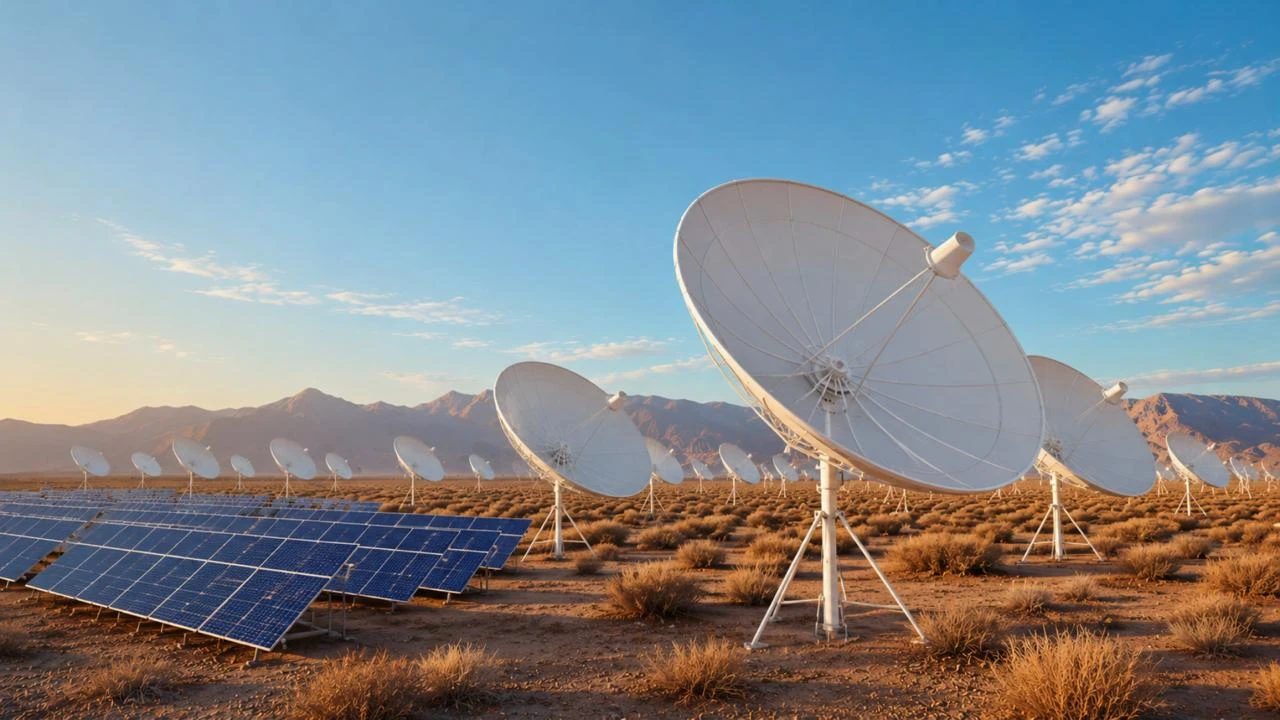
Flagship instrument
FRONTIERS
FRONTIERS is the project that invites us to rethink how we build and operate radio telescopes. We are designing an array in Chile to continuously monitor radio transients, with sustainability incorporated from the beginning: reducing cost, complexity, and energy consumption without sacrificing the sensitivity required for the science.
To achieve this, we are developing a modular Large-N, Small-D phased array of 25 6m dishes operating at centimetric-waves. Its room-temperature receivers, reconfigurable digital backend, and real-time processing pipeline are being designed with energy efficiency in mind, allowing the telescope to operate on photovoltaic power. The modular design also allows us to expand the array as resources become available.
FRONTIERS is a collaboration between UC Chile, the Max Planck Institute for Radio Astronomy, and ANID CPS-RTC Technological Center. We are currently validating the core technologies that will make this approach possible, laying the groundwork for the future expansion of the array.
- Antennas
- 25
- Dish size
- 6 m
- Band
- 1–2 GHz
- Sampling
- 5 GS/s
Engineering teams
FRONTIERS is built by four teams working side by side.
Antenna (Mechanical) Design
GFRP reflector with an embedded aluminum mesh, modular dish joints, feed supports and the antenna mount — modelled in CAD, validated with finite-element analysis and designed to be manufactured locally.
Antenna (RF) Design
L-band (1–2 GHz) feeds, RF front-ends and complete RF chains, plus experimental manufacturing of RF components by 3D printing and copper electroplating.
Digital Signal Processing
FPGA / RFSoC backends that sample at 5 GS/s, channelise the band and search for dispersed bursts; SDR systems and spectrum surveys from 500 MHz to 18 GHz for site selection.
Energy Modelling
Off-grid photovoltaic and LFP battery systems, thermal design of enclosures and reliability studies so the antennas can keep observing at remote sites.
Science
The questions that drive the instruments.
Fast Radio Bursts
Millisecond radio flashes from distant galaxies. We work on targeted searches for repeating FRBs, FRB simulations, and on the instruments and backends needed to detect them in real time.
Magnetars & pulsars
Magnetars are leading FRB progenitor candidates. Using Phased ALMA we detected pulses from the Galactic Centre magnetar at millimetre wavelengths, and we study the polarization of magnetars near the Galactic Centre.
Machine learning for transients
Deep-learning pipelines for the automatic detection and classification of radio transients in large data streams, separating genuine signals from radio-frequency interference.
Resource-aware RF technology
Low-cost RF and digital technology for radio astronomy that can also serve satellite communications — including turning FRONTIERS into a dual-use instrument with an X-band ground-station link.
Partners & facilities
Astroengineering Center UC (AIUC)
Home of the lab, at Pontificia Universidad Católica de Chile.
Max Planck Institute for Radio Astronomy
RTL is a Max Planck Partner Group with the MPIfR (Bonn, Germany).
ANID CPS-RTC Technological Center
Partner in the development of FRONTIERS.
ALMA
Phased-array observations of radio transients at millimetre wavelengths.
See our publications for the results of this work.